

Events@IIMB
Managing the Mind: The Inner Dimension of Effective Leadership
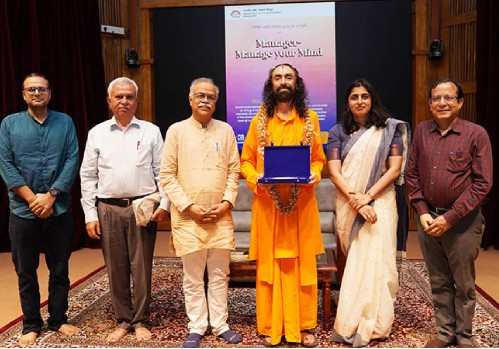
A lecture titled “Manager – Manage Your Mind” at IIM Bangalore examined the role of mind management and spirituality in modern leadership and organisational life. Drawing from his book The Science of Mind Management, Swami Mukundananda explained how inner discipline, self-awareness, and conscious thinking directly influence managerial effectiveness and personal well-being.
He observed that while premier institutions train individuals in professional and managerial skills, spirituality helps clarify the deeper purpose behind those skills. Describing spiritual knowledge as a complementary discipline, he highlighted four capacities essential for today’s professionals: self-awareness, universal awareness, self-mastery, and professional mastery. Together, these enable individuals to respond thoughtfully rather than react impulsively in high-pressure environments.
Countering the idea that spirituality requires withdrawal from professional life, Swami emphasised service, resilience, and mindset as central to leadership success. Citing organisational research, he noted that many professional failures arise not from lack of competence but from an inability to manage one’s thoughts and emotions. Effective leadership, he concluded, begins with mastering the mind—placing inner clarity at the heart of sustainable management practice.
Comparative Perspectives on Strengthening Primary Health Care Reforms
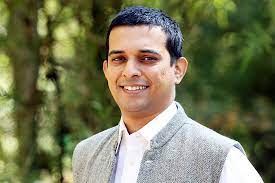
Professor Arnab Mukherji, Chairperson of the PGPPM programme and faculty member in Public Policy, participated in a regional roundtable on “Strengthening Primary Health Care Through Evidence-Informed Policy and Practice” at the National University of Singapore. The roundtable brought together policymakers, researchers, implementers, and development partners from across Asia to exchange experiences from ongoing primary health care (PHC) reforms and explore how research evidence can be more effectively integrated into policy decisions.
During the discussions, Prof. Mukherji presented comparative insights drawn from seven to eight country contexts, including Nepal, India (Chhattisgarh), Bangladesh, Bhutan, Sri Lanka, Maldives, Timor-Leste, and Thailand. His presentation was based on research conducted through the Model2PHC consortium and highlighted similarities and contrasts in reform pathways, implementation challenges, and policy responses across diverse health systems.
The roundtable was organised by the Asia Pacific Observatory on Health Systems and Policies (APO), a collaborative platform that supports governments and institutions in advancing evidence-informed health system strengthening across the Asia-Pacific region.
Study Highlights Gaps in Media Framing of Climate Change as a Health Issue

Prof. Deepti Ganapathy, faculty in the Management Communication area, has co-authored a research article published in The Lancet Planetary Health examining how news media frame climate change as a public health issue. Titled “The evolution of news coverage about climate change as a health issue: A decadal analysis in China, India, and the USA”, the study offers one of the most comprehensive cross-national analyses of climate–health coverage to date.
Analysing more than 22 million news articles published over a decade in the world’s three largest carbon-emitting countries, the study finds that climate change is rarely presented through a public health lens, despite strong scientific evidence linking it to health outcomes. When health impacts are mentioned, coverage tends to focus on immediate effects such as extreme weather, heat exposure, air pollution, and food insecurity, with limited attention to vulnerable populations, long-term solutions, or public health expertise.
The findings suggest that the absence of a health framing may constrain public engagement with climate change and highlight the potential of health-oriented reporting to strengthen public understanding and policy discourse.
