

Transforming India’s DPI: Shift from scale to ecosystem impact
– Professor R Srinivasan and Dr. Vikas N Prabhu
IIM Bangalore
Digital public infrastructure in India moves beyond scale to become transformative by enabling innovation, adoption, and ecosystem-wide value creation.
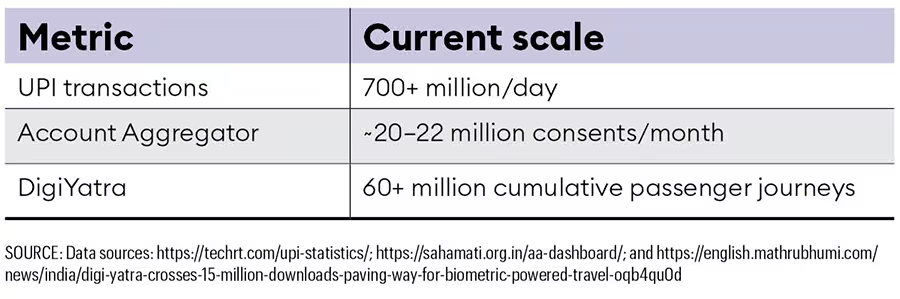
Every day in India, more than 700 million UPI transactions are executed, tens of millions of consented data flows move through the Account Aggregator framework each month, and a rapidly growing number of passengers pass through airports using biometric identity systems such as DigiYatra. These are not isolated achievements. They signal the emergence of digital public infrastructure (DPI) as a foundational layer of India’s economy, quietly powering interactions across finance, mobility, commerce, and governance.
Yet scale, impressive as it is, tells only part of the story. The more consequential question for policymakers and business leaders is this: When does digital infrastructure stop being a utility layer and start becoming a platform for transformation? Answering that question requires moving beyond metrics of scale toward a deeper understanding of DPI maturity.
Understanding DPI maturity
A growing body of research has proposed how countries can assess the maturity of their DPIs. Institutions such as the UNDP, OECD, World Bank, and several industry-led initiatives such as NASSCOM’s maturity index and the Global Solutions Initiative’s framework have proposed models that evaluate dimensions such as governance capacity, interoperability, digital inclusion, regulatory readiness, and technological infrastructure.
These approaches have played an important role in moving the conversation beyond narrow measures of digitisation toward a broader understanding of how digital systems create public value. They have also helped policymakers recognise that successful DPI requires not only focused technological deployment, but also institutional coordination, public safeguards, and ecosystem participation.
Yet, existing frameworks tend to focus either on the readiness of governments to implement digital systems or on the presence of foundational technological capabilities. While these are critical starting points, they are less effective in explaining why some DPIs evolve into economy-wide platforms for innovation while others struggle to move beyond fragmented adoption.
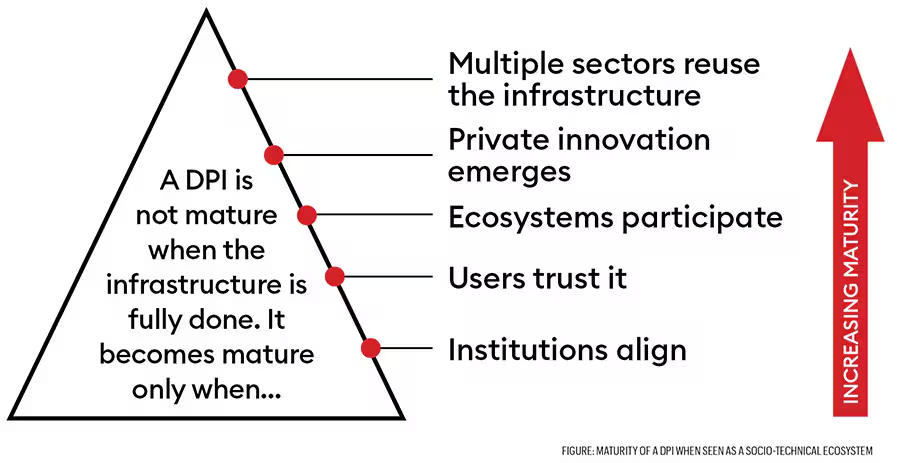
India’s own experience demonstrates that DPI maturity is not merely a function of infrastructure creation or user onboarding. It also depends on whether the ecosystem generates sustained institutional integration, market participation, reusable innovation, and behavioural adoption at scale. This requires looking at DPI not simply as a technology stack, but as a living socio-technical ecosystem evolving through different stages of maturity.
Beyond deployment: Distinguishing mature DPIs
India’s DPI landscape offers a striking contrast. Systems such as Aadhaar and UPI have evolved into economy-wide public rails, deeply embedded in everyday transactions and enabling new forms of innovation. At the same time, several other DPIs continue to operate in extended pilot or early growth phases, with uneven adoption and limited ecosystem spillovers.
This divergence raises a fundamental question: How does one distinguish a mature DPI from one that is still evolving?
Global thinking on DPI has made important strides in recent years. While the frameworks presented earlier in this article have served to broaden the lens to include governance readiness, interoperability, and inclusion, there has been no comprehensive account explaining why some DPIs evolve into platforms that catalyse innovation across sectors while others remain confined to narrow use cases.
India’s experience suggests that maturity cannot be understood purely through the lens of technology or rollout; it must be viewed in terms of whether a DPI evolves into a self-sustaining socio-technical ecosystem.
A three-stage model: Implementation → Adoption → Leverage
A more useful way to assess maturity, therefore, is to examine how DPIs evolve across three stages: implementation, adoption, and leverage. Drawing on our work in the State of India’s DPI Report 2025, we propose a simple but powerful framework to assess DPI maturity across these three stages:
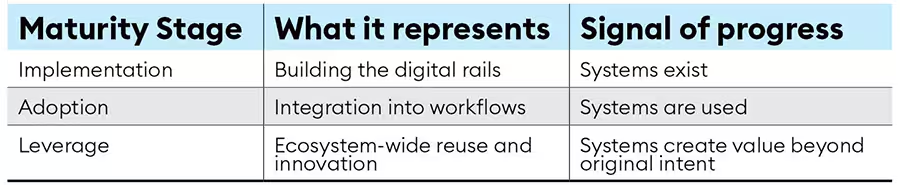
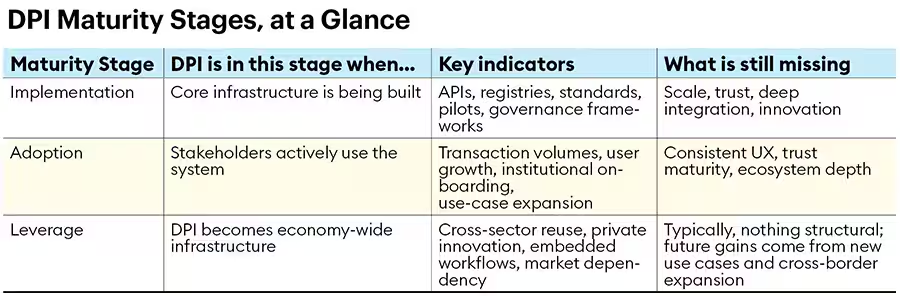
In the first stage, implementation, the focus is on building the underlying digital rails: identity systems, payment architectures, registries, APIs, and governance frameworks. At this point, the system exists, but its potential remains largely unrealised.
The second stage, adoption, begins when institutions, businesses, and citizens integrate these rails into everyday workflows. Transaction volumes grow, user participation increases, and the system demonstrates operational viability.
However, it is only in the third stage, leverage, that a DPI becomes transformational. Here, the infrastructure is no longer just used; it is reused. It enables cross-sector innovation, shapes market behaviour, and becomes embedded in the functioning of the economy itself.
This distinction between adoption and leverage is critical. Much of the current discourse on DPI maturity equates success with scale, often measured in terms of user numbers or transaction volumes. While these metrics are important, they are insufficient.
A system can be widely used and still fail to generate broader ecosystem value. For instance, several European countries have achieved near-universal adoption of digital identity systems, but many remain confined to authentication and public service access rather than becoming open innovation rails powering broader ecosystems of payments, commerce, credit, and data exchange.
Maturity, in the true sense, emerges when a DPI becomes generative: when entrepreneurs build on it, multiple sectors repurpose it, institutions reorganise around it, and users come to depend on it as default infrastructure.
India’s DPIs through this lens
Viewed through this three-stage maturity lens, India’s DPI landscape reveals different levels of maturity across sectors.
The Ayushman Bharat Digital Mission, for instance, represents a strong implementation-stage system, with robust registries and a consent-based data-sharing architecture in place, but with ecosystem development still underway.
The Account Aggregator framework appears to be in the adoption phase, processing on the order of 20–22 million consent requests each month and seeing increasing participation from banks, NBFCs, and fintechs.
ONDC exhibits similar characteristics, with expanding institutional engagement but evolving user behaviour.
In contrast, UPI, with over 700 million daily transactions, has clearly entered the leverage stage, functioning as a backbone for digital payments, fintech innovation, and even government applications.
Aadhaar exhibits comparable characteristics through its widespread reuse across welfare delivery, financial services, and identity verification systems.
Several of India’s DPIs have leveraged ecosystems at population scale—for instance, the examples of UPI, Account Aggregator, and DigiYatra highlighted in the opening paragraph—which go on to demonstrate high levels of embeddedness in the everyday functioning of markets and public services.
While the numbers signal progress, their real significance lies in what they enable: new business models, more efficient markets, and reconfigured user experiences.
What this means for leaders
The deeper insight for decision-makers is that maturity is not a function of technological completion, nor is it simply the outcome of scaling usage. What distinguishes a mature DPI is its ability to anchor an ecosystem.
This requires a careful balance between state capacity, which enables infrastructure creation; market participation, which drives innovation; and citizen adoption, which sustains trust and relevance.
The interplay between these three forces—samaaj, sarkaar, and bazaar—ultimately determines whether a DPI remains merely utility infrastructure or evolves into a transformational ecosystem.
For policymakers and business leaders, the strategic challenge is therefore shifting. The question is no longer how to build and scale digital infrastructure. It is how to ensure that these systems are designed, governed, and extended in ways that enable continuous reuse and innovation.
In other words, the real test of DPI maturity is not the scale at which it operates, but the extent to which it multiplies value across the economy.
Because, in the final analysis, DPI becomes truly transformational not when it is widely used, but when it becomes impossible to build without.
Dr. Vikas N Prabhu is a Post-doctoral fellow at the Center for Digital Public Goods, Indian Institute of Management Bangalore.
Professor R Srinivasan is a Professor of Strategy and Chairperson of the Center for Digital Public Goods, Indian Institute of Management Bangalore.
Source: Forbes India
