

AI and the future of management education and innovation
– Prof R Srinivasan & Dr. Amar Saxena
IIMB & RT-MSSU
As AI transforms management education, experience, critical thinking, judgment, and innovation become essential.
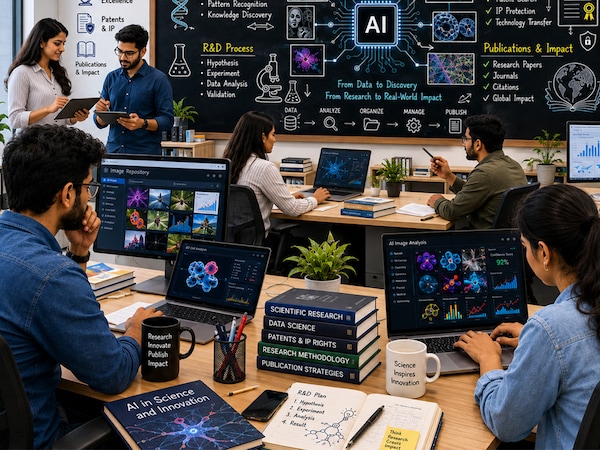
One of the cornerstones of the educational system has been innovation. Every business school, every management programme, and every corporate initiative uses it with almost religious reverence. It is one of the favoured courses in a management institute. Senior executives pay a handsome amount for a week of learning. It appears in mission statements, accreditation documents, and the speeches of deans and directors.
The two engines of innovation
Innovation scholars Morten Berg Jensen, Björn Johnson, Edward Lorenz, and Bengt-Åke Lundvall, in their seminal 2007 paper Forms of Knowledge and Modes of Innovation, argued that innovation emerges from two different but complementary forms of knowledge creation. One focused on scientific and technology-based innovations (the STI mode), and the other focused on learning-by-doing, by-using, and by-interacting (the DUI mode).The STI mode relies on formal scientific knowledge, R&D, patents, publications, and codified expertise. It assumes that learning begins with formal knowledge. Students acquire expertise in theories, frameworks, concepts, and analytical tools. Innovation then emerges from the application of this codified knowledge.
Call it the Science Engine.
This model served the industrial and information ages remarkably well. When information was scarce, mastering established bodies of knowledge created enormous value. Firms that invest in R&D, scientific partnerships, and technology consistently produce breakthrough innovations: new products, new processes, and new materials.Management education has been running on the Science Engine since its inception. Lectures, reading lists, and examinations are all instruments of the Science Engine. They are designed to fill students with codified knowledge and then test how much they have retained and how competently they can apply it.The DUI mode relies on experiential learning, tacit knowledge, practical problem-solving, and interaction among people. Learning by doing. By interacting. By failing. By collaborating. With customers, suppliers, and even competitors. This mode recognises that much of what makes individuals effective is not acquired through formal instruction but through experience, experimentation, collaboration, observation, and reflection. This knowledge is tacit, contextual, and deeply human. It cannot be read. It can only be lived. One does not learn leadership by reading about leadership. One learns it by leading. One does not develop judgment by memorising case studies. One develops it by making decisions under uncertainty and living with the consequences
Call it the Experience Engine.
Here’s the truth: Neither engine alone is sufficient. The organisations that innovate most powerfully and most consistently are those that combine both, the rigour of scientific knowledge and the wisdom of lived experience, in continuous dialogue with each other. And then, in November 2022, OpenAI dropped version 3.5 of ChatGPT, and Generative AI took a quantum leap. Suddenly, codified knowledge became easily accessible and much better. Significantly better than humans.
AI has colonised the science engine
Now, the plethora of AI models can create reports better than we ever could. It converts a newbie into an ace designer. It can create presentations that we only dreamed of. And faster. AI is challenging the very foundation of the STI model. If machines can instantly retrieve, summarise, explain, and apply codified knowledge, then possession of that knowledge alone ceases to be a meaningful differentiator. In a world where every student has access to an on-call digital expert, the value of merely knowing declines rapidly. This cataclysmic disruption will grow exponentially in the months and years ahead, making STI even more redundant.
Is it a threat to education? In a way, yes. The critical question is not whether management education is in trouble. The question is what management education is actually for. So, in a way, it is an invitation as well. Perhaps the most important one we have ever received. To finally get serious about what innovation actually requires
The future path lies in the DUI mode, the Experience Engine. It is something that AI cannot replicate, at least not yet. Because experience is not information. It is transformation. You cannot download wisdom. You cannot prompt your way to judgment. You cannot generate, through a chat interface, the hard-won understanding that comes from leading a team through a crisis, navigating a negotiation that matters, making a decision with incomplete information, and living with the consequences.DUI mode gives you skin in the game. This is a comparative advantage of humans that AI cannot easily replicate.
Innovation requires struggle – and we have been removing it
Innovation does not emerge from comfort. It emerges from struggle. From the productive friction of encountering a problem you cannot immediately solve, sitting with the discomfort of not knowing, and working your way, painfully and imperfectly, towards an answer.Neuroscience has confirmed what great teachers have always known: Our brains learn and grow most powerfully when challenged just beyond their current capacity. The struggle is not a sign that learning is going wrong. The struggle is the learning. And herein lies the paradox. AI, used without wisdom, removes the struggle. It gives students the answer before they have even grappled with the question. In many cases, before they have even understood the question. It takes away the beautiful array of questions, both strategic and operational. It resolves the cognitive discomfort that is the very engine of intellectual growth.Will our education system, then, produce highly credentialled graduates who have never truly struggled with a hard problem? And who therefore lack the one capacity that innovation most demands: The ability to persist, experiment, adapt, and think their way through newer, unknown challenges.This is the Struggle Paradox.
AI is eroding our thinking capacity at the precise moment when it is most valuable. And it is leading to an erosion of our capacity for genuine innovation at the precise moment when innovation is the only sustainable competitive advantage.
What must change
If AI can teach students what we currently teach them, what is left for educators to do? The response cannot be to ban AI. It is neither feasible nor desirable. AI is a tool of extraordinary power, and students who learn to use it well will be significantly more capable than those who do not. The future path lies in radically rebalancing the curriculum towards the DUI mode.
Classrooms must become laboratories of struggle. Not places where knowledge is delivered, but places where students encounter genuine complexity, ambiguous, human, contested complexity, and are required to work through it together. Socratic debates, live case studies, and simulations that do not have predetermined right answers. The professor’s role shifts from expert-in-residence to architect of productive discomfort. Creating confusion in the classroom.Interaction must be built into the architecture of learning, not as an add-on, but as the primary mode. Interaction with practitioners who bring the tacit knowledge of experience. Interaction with peers from different disciplines, cultures, and industries. Interaction with real organisations facing real problems. Management educators already know this. Hence the OJT, expert sessions, and case discussions. These aspects move from the periphery to the centre.It also means that assessment must change fundamentally. If AI can produce the output, it is no longer the point. What must be assessed is the process, the quality of thinking, the rigour of judgment, and the courage of argument. This was always the case. The end report had become a surrogate for assessing thinking ability. No longer. Students have to learn to use AI as a thinking partner, not a thinking replacement. To interrogate its outputs with domain knowledge and critical judgment. To ask what AI cannot see, because it has no experience, no values, and no stake in the outcome.
The uncomfortable truth
We are all navigating uncertain waters. Management institutions need to place these uncomfortable and ambiguous questions at the centre of their next strategic review. Those that answer this question boldly, and rebuild their curricula around the answer, will produce graduates who are genuinely equipped for a world in which knowledge is abundant and thinking is rare.Innovation has always required more than knowledge. It has required struggle, which gives us wisdom. It comes from experience, which comes from judgment. And it comes from out-of-the-box thinking when we have our backs to the wall and nothing seems to be going right.AI has not changed this truth. It has simply made it impossible to ignore any longer. And therein lies the invitation
Source: Forbes India
