

Alumni Author: R Venkatraman(RV Raman), PGP 1988
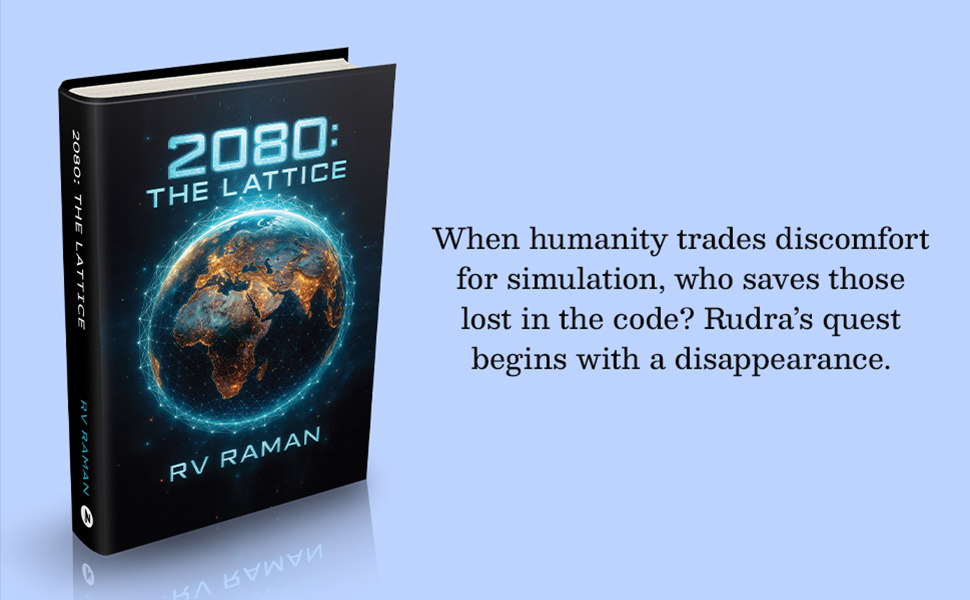
Writing under the pen name RV Raman, R. Venkatraman (PGP 1988) brings a distinctive perspective shaped by decades of professional experience and a lifelong engagement with technology and ideas. Having lived through the pre-internet era and the rise of artificial intelligence, his latest novel, 2080: The Lattice, reflects a deep curiosity about how rapidly evolving technologies reshape society. Drawing from his background in consulting and his keen observational skills, RV Raman explores AI not as distant science fiction, but as an accelerating reality already influencing our present. In this conversation, he reflects on the surprises of technological progress, the ethical risks embedded in data-driven systems, and the creative freedom that science fiction offers compared to his earlier corporate thrillers.

In 2080: The Lattice, you imagine a future deeply altered by technology. As someone who has lived through the pre-internet era and the digital age, what changes have surprised you the most?
I have been surprised by the sheer speed at which computing technology has evolved. Whether it is speech recognition, data communication, storage, miniaturisation, or chip capability, progress has been relentless—constantly galloping. Not merely growing, but accelerating. Other areas of technology (such as materials science, 3D printing, etc.) have grown too, but not at the pace of computing technology.
Most recently, the emergence of AI and its growing ubiquity has taken me by surprise. I now believe that AI is going to bring about a fundamental shift. While my novel contemplates many changes by 2080, I would not be surprised if some of them occur earlier.
Every book reflects a concern or curiosity of its author. What was the moment or idea that first made you think, “This is a story that needs to be told”?
I was watching my son work on an online course in AI and machine learning. When the time came to test his creation, he needed data. In classical software development, we often used test data to validate our programs. This data might have been erroneous or skewed, but it served the purpose of checking whether the programming was correct.
When I suggested this approach, my son gave me a look that said it all.
That was when a question popped into my head: What if critical AI systems were deliberately trained on tampered data? As I read more about AI and ML, the possibilities grew increasingly disturbing. Whether deliberate or inadvertent, allowing biases to creep into AI systems is a dangerous proposition.


Your earlier works were rooted in crime and corporate intrigue. What was the most challenging part of shifting into science fiction — and what was the most liberating?
Writing science fiction itself was not the challenge—I had read enough of Asimov, Arthur C. Clarke, and others. The transition from crime to sci-fi was smooth and enjoyable. The real challenge emerged after the manuscript was complete. I discovered that publishers who had been happy to publish my crime fiction were reluctant to take on my science fiction. Perhaps changing genres is seen as a high-risk move.
The liberating aspect was the greater creative freedom that sci-fi allows. When writing corporate crime, I am bound by existing laws and regulations; I cannot step outside their boundaries. Science fiction, on the other hand, explores what might happen well into the future. I can create my own laws and norms—as long as they sound plausible.
Many readers are fascinated not just by the worlds you create, but by how you observe the real one. What habits or perspectives help you keep your writing relevant and insightful?
One of the fundamental skills of an advisor is the ability to observe, perceive, and analyse situations quickly. Having spent decades in consulting firms, I developed this ability. We would walk into an unfamiliar organisation and begin gathering insights almost immediately. This skill proved invaluable, especially in my first four “corporate thrillers,” which dealt with white-collar crime in corporate India.
What do you hope readers feel or think about after finishing 2080: The Lattice?
Two thoughts.
First, AI is neither a hero nor a villain. It is not a panacea. As with all technology, everything depends on how we humans choose to use it.
Second, those of us who create AI must do so responsibly. We must ensure that we do not introduce or propagate biases in AI systems. For instance, training an AI model on data that has not been thoroughly cleaned could be disastrous. Imagine an AI system controlling a commercial flight as it crosses an ocean—there is zero margin for error.
Did any part of the story change significantly from your original idea while writing it?
I initially wanted to include more technical detail about AI so that lay readers could learn something while reading the novel. However, whenever I attempted this, I found that what I had written became obsolete or inaccurate within weeks. Eventually, I abandoned that approach.
What was the most surprising thing you discovered — about the book or about yourself — during the writing process?
The speed of technological change. Even as I was writing, technology was evolving around me. In my novel, the internet has evolved to a point where it carries all five senses—sight, sound, taste, smell, and touch—in digital form, making virtual presence indistinguishable from physical reality.
Not a fortnight passed without my coming across an article describing advances in artificial sight, hearing, or other senses. What I had assumed would be far into the future was already beginning to take shape.
You began writing later than most authors. What would you say to people who feel it’s “too late” to start something new or pursue a long-held interest?
Quite simply, it is never too late. As long as you can imagine stories and string together sentences to communicate them, you can write. In fact, the older you are, the richer your repertoire of experiences and perspectives—assets you can bring powerfully to your stories.
2080: The Lattice ultimately invites readers to look beyond technology itself and focus on human responsibility. RV Raman is clear that AI is neither inherently good nor bad—it is the choices made by its creators that determine its impact. As systems grow more powerful and pervasive, the novel underscores the importance of designing AI thoughtfully, without bias, and with accountability, especially in contexts where errors can have grave consequences. At the same time, his own journey as a writer offers an inspiring reminder: it is never too late to pursue a creative calling. With experience, imagination, and curiosity, new beginnings—and new stories—remain possible at any stage of life.
