

Alumni Author: Startup or Corporate – Prasad S N, EGMP 2023
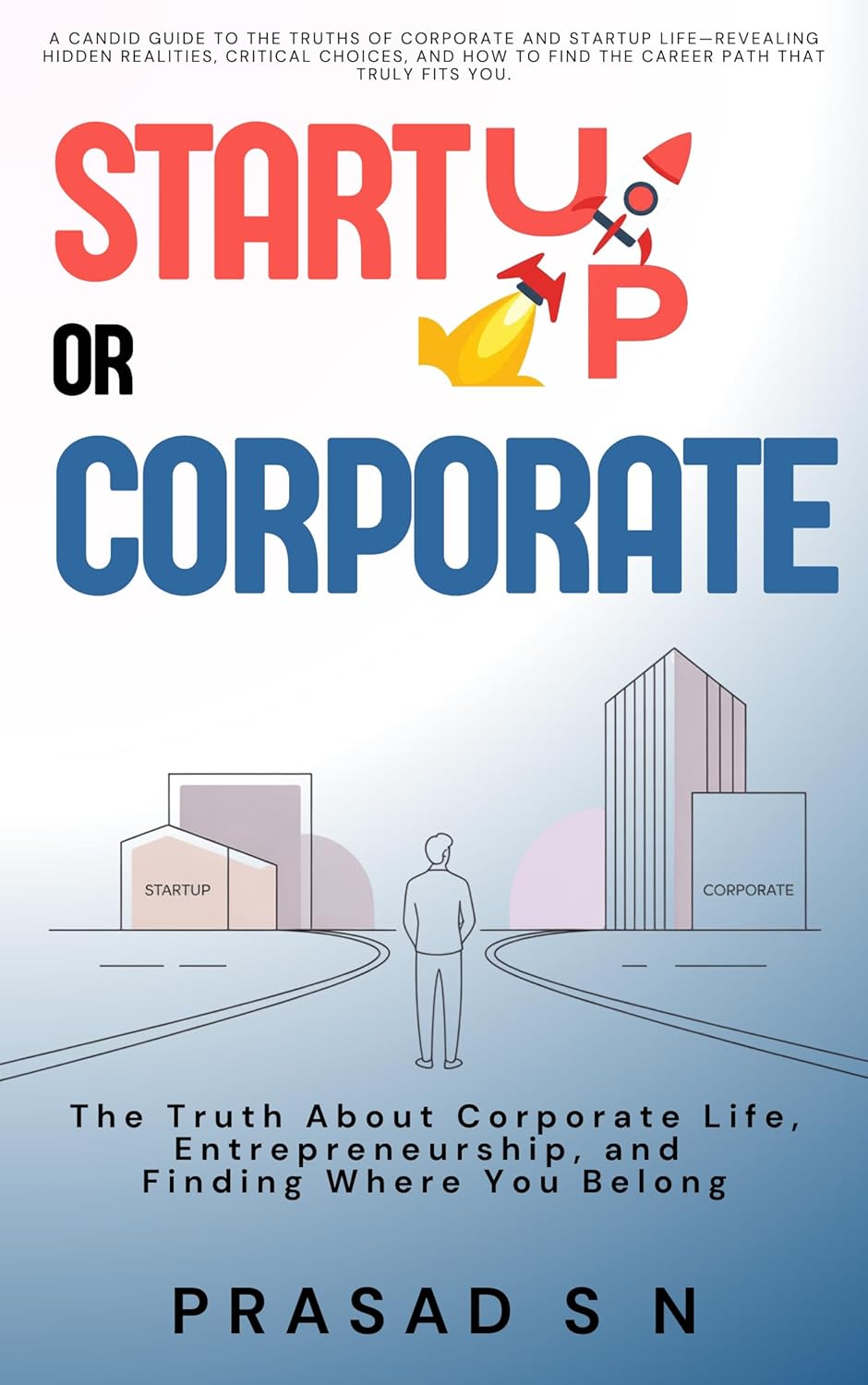
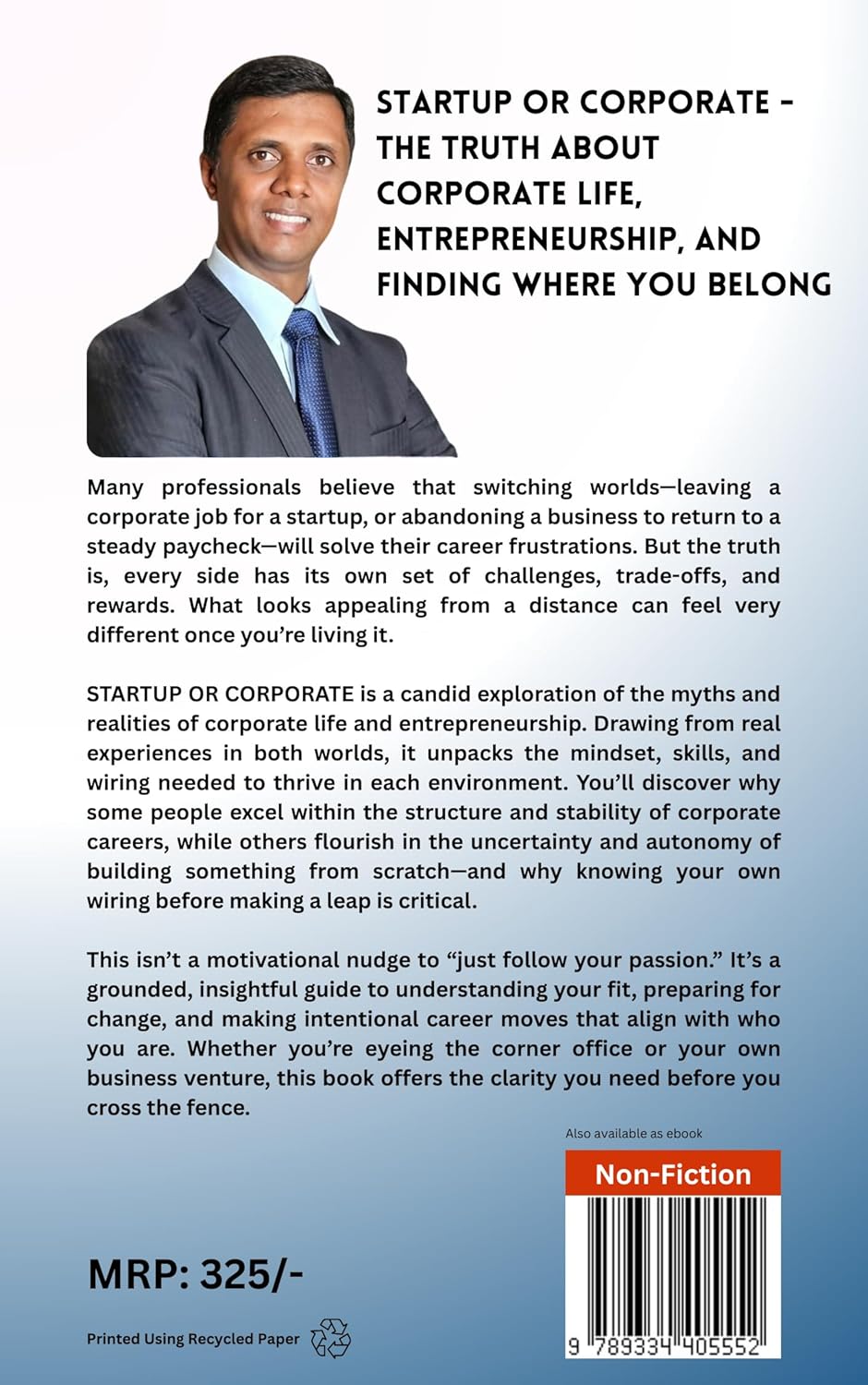
In this conversation, we speak with Prasad S N (EGMP 2023), an IIM Bangalore alumnus whose book Startup Corporate Entrepreneurship: Finding Where You Belong moves beyond the usual binaries of career choice to explore something far more personal—the quiet unease of feeling underutilised and the cost of acting on it.
Drawing from lived experience across corporate and entrepreneurial journeys, he reflects on the realities that often go unspoken: the emotional weight of uncertainty, the trade-offs behind both paths, and the importance of choosing consciously rather than by default. What emerges is not a prescriptive guide, but an honest exploration of belonging—what it means, and where it can be found.
What was the central question or dilemma you wanted to explore through Startup Corporate Entrepreneurship: Finding Where You Belong?

On the surface, Startup or Corporate looks like a career-choice book, a guide to help you pick a lane. But that was never the real question burning inside me when I sat down to write it. The real question was :
Why do capable, successful people feel underutilized and what does it cost them when they finally do something about it? Coming purely from my own experience.
A “startup or corporate” framing suggests a rational, spreadsheet-style comparison. Pros. Cons. Risk-adjusted returns. But what I was actually trying to write about was the invisible tax that comfort levies on people who are built for more. That’s what started this whole journey for me. And I realized there were millions of professionals sitting in respected roles, drawing predictable salaries, ticking every external box of success, and feeling that exact same unease and had no honest book to tell them what actually happens when they act on it.
Most books on entrepreneurship I’d ever read either romanticized the leap and gives strategies to build company and never about individual’s journey. They neither felt like what I actually experienced standing in a retail stall in Bangalore, killing my ego one transaction at a time, watching people walk past my sustainability products with complete indifference.
So, the central dilemma I wanted to sit inside and hold without resolving too neatly was not “which path is better.” Not “which path makes more money” or “which path is braver.” The life I lived, taught me that both paths involve genuine sacrifice. Neither is wrong. They’re just optimized for different human beings and for different seasons in one’s same life.
The idea of “belonging” stands out in the title. What does belonging mean in the context of navigating between startups and corporate roles?
Belonging, in this context, is not about finding your tribe or your passion. Belonging means finding the environment where the version of you that you’re actually becoming can exist without constantly fighting the system around it.
I had a very specific moment that crystallised this for me, when I was standing in a retail stall not presenting to a boardroom, not sitting in a strategy review but just standing on the road, doing physical stalls, watching people walk past my display without any acknowledgment. People I would have managed in my corporate life walked right past me. I was killing my ego, one interaction at a time.
It’s not about whether the environment is comfortable or prestigious. It’s about whether it is activating the real you. Some people belong inside a large organisation’s structure, the systems, the teams, the clear accountability chains — that’s where they do their best work. Others, the moment they step outside that structure, come alive in a way the organisation could never quite accommodate.
The tragedy is that most people never find out which category they’re in, because the question is too uncomfortable to ask seriously.
Many professionals today feel caught between the structure of corporate roles and the uncertainty of startups. Does your book offer a middle path, or help readers make a clearer choice?
I want to be honest about this, because too many books pretend to offer a middle path and then quietly push you toward one side.
This book does not advocate for entrepreneurship. I say that plainly in the About the Book section, am not trying to convince you to quit your job and am not celebrating entrepreneurship and not condemning corporate life as a trap.
What I try to offer is a framework for choosing your struggles consciously. Because here’s what I learned: both paths involve struggle. Corporate struggles, bureaucracy, limited autonomy, someone else’s priorities driving your time, the anxiety of a reorganisation that could eliminate your role overnight. Entrepreneurial struggles, financial insecurity, identity crisis, isolation, carrying everything personally.
Neither set of struggles is objectively worse. They’re just different. The question the book tries to help you answer is: which struggles align with who you actually are?
If anything, the middle path I describe is the one most mid-career professionals don’t consider: hybrid entrepreneurship. Starting while still employed. Running the minimum viable experiment before handing in your resignation. The data from Harvard on this is clear, people who start while employed take better decisions, attract better early customers, and fail less often.
Was there a specific experience or turning point that shaped the direction of this book?
There were many as listed in book, the bus ride to Hyderabad with 1000+ diaries, standing in stalls with people walking past me, the years with no salary, the evening in a restaurant restroom where I cried because I felt I had robbed my family of small luxuries.
There is no book that tell you how to honestly answer or handle these internal feelings we as founders go through. There are plenty of people that talk about push through, never give up, the breakthrough is just around the corner. But there was almost nothing about the difference between building tired and drowning tired. Nothing that told you it was okay to stop. Nothing that described the exact texture of what years of financial sacrifice, identity loss, isolation, and hope looks like from the inside.
I wrote the book I needed to read before I started.
Why do you think organizations often struggle to support entrepreneurial thinking within corporate structures?
Because corporate structures are risk distribution systems. That’s not a criticism but when you’re managing thousands of employees and billions in market capitalisation, you can’t afford recklessness. The approval chains, the committees, the documentation, they exist for very good reason.
Creating systems to manage risk, corporations often create their greatest risk, paralysis. I’ve seen companies spend more money on a risk assessment than the actual risk would have cost them. I’ve seen innovations die not because they were bad ideas, but because they couldn’t survive the layers of approval designed to catch the one-in-a-hundred bad idea.
When I was in corporate, a significant strategic pivot took months and tons of slides approved at many layers. When I ran my startup, I pivoted the entire business model in a week. One notebook. My co-founder. Scratch calculations.
Corporations can support entrepreneurial thinking, but only if they’re willing to structurally protect a small number of people from the standard accountability mechanisms. Most aren’t willing to do that, because the accountability mechanisms exist for the good of the whole organisation. That tension is probably irresolvable.
How does this book challenge or refine some of the common assumptions people have about startups and corporate careers?
The first assumption I dismantle is that entrepreneurship is about the idea. It is not. It is about execution in conditions of radical uncertainty, with no inherited trust, no brand to borrow credibility from, and no safety net to catch your mistakes. The idea is almost irrelevant. What matters is whether you can sell to strangers who don’t know you, manage cash flow with the discipline of someone who has nothing to spare, and maintain psychological stability when everything is uncertain simultaneously.
The second assumption: that corporate experience is a liability in a startup. I completely disagree. My 14+ years in corporate, stakeholder management, process design, project execution, understanding how large buying organisations make decisions, that all transferred. The problem is that it transferred with a delay, because my first instinct was always to apply corporate frameworks to startup problems, and those frameworks don’t fit. The learning was in understanding when to use what I knew and when to unlearn it.
The third assumption and this one is cultural in India specifically is that returning to corporate after a startup failure is easy. It is not. I say in the book quite plainly: you can always go back. Entrepreneurship isn’t a one-way door. You will return with skills that corporate executives don’t have, startup experience, resourcefulness, the ability to function without structure. The problem, honestly, is that Indian corporates don’t yet value this. My own months of job search (over a year) after closing Grewind confirmed that. But I believe that gap is closing, and I believe people with genuine startup experience are undervalued in our hiring market right now.
Who is the reader you had in mind while writing this, and what is the one key takeaway you hope they walk away with?
The reader I was writing for is sitting in a corporate office after 6 PM, when the noise has faded, and feeling something they can’t quite name. Not dissatisfied exactly. Not failing. Just… unfinished. They’ve been there ten, twelve, fifteen years. They have the title, the salary, the LinkedIn profile that gets responses. And every evening, there’s this quiet unease that refuses to disappear. That’s the reader. And they’re far more common than any engagement survey admits. Gallup tells us 62% of employees worldwide are not actively engaged. Most of those people are not burnout cases. They’re underutilised people who have learned to negotiate with their own potential.
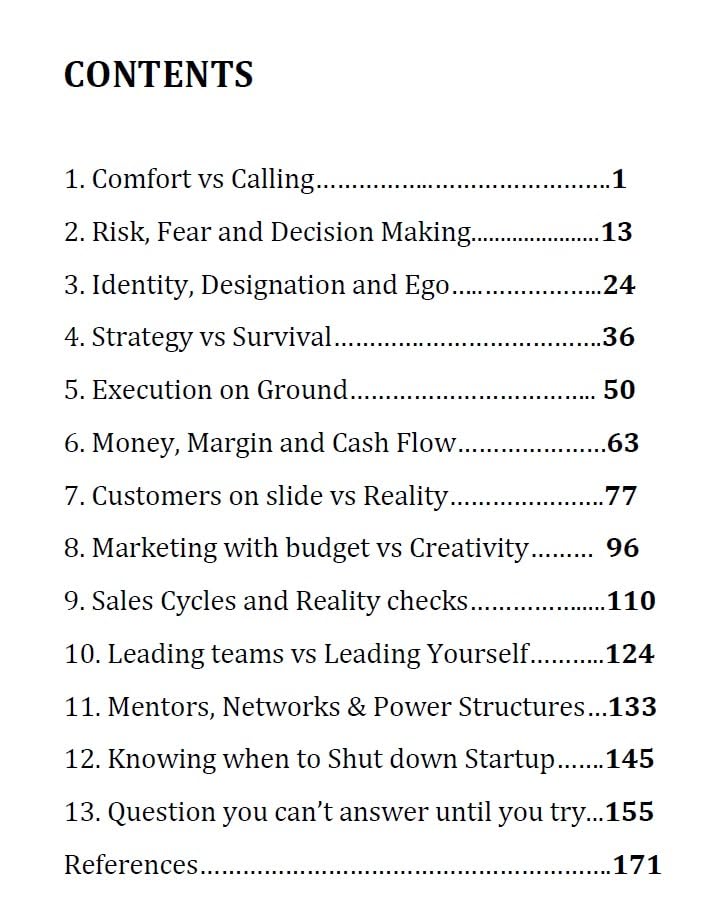
The one key takeaway, if I had to distil 180 pages into one sentence is this: whatever you choose, choose it consciously, not by default.
Don’t stay in corporate because you’re too afraid to leave. Don’t leave because startup culture made you feel like staying was settling. The act of choosing deliberately, understanding the trade-offs, being honest about your values, knowing what your family can actually sustain, that is the practice. Whether you end up in corporate or a startup or something in between, that conscious choice is the difference between a life you’re building and a life you’re merely surviving.
If someone finds themselves at a crossroads between stability and experimentation in their career, what would you want them to reflect on after reading this book?
Five questions. I put them in the final chapter, but they deserve to be said plainly here.
A. Can you afford the financial hit — genuinely? Not do you have savings, but can your family weather three to four years of significantly reduced income? Passion doesn’t pay rent. Be realistic about your runway and your obligations.
B. Are you running from something or toward something? If you’re running from a bad boss or office politics, you’ll carry those frustrations into your startup with different faces. Running toward a specific problem you want to solve — that has a chance.
C. Which of your skills are actually portable? Some of your corporate success is due to the brand behind you, the systems around you, the team supporting you. What remains when all of that disappears? Be brutally honest.
D. Can you sell? I cannot overstate this. If you cannot hear “no” from strangers and keep going, if asking for money makes you deeply uncomfortable, entrepreneurship will break you. Selling is not optional — it is the job.
E. the question nobody asks before they start: how will you know when to stop? What’s your quit condition? Time-based? Financial? Personal? Successful founders are not just good at persisting. They’re good at knowing when persistence has become stubbornness.
The book doesn’t answer those questions for you. It can’t. Your equation isn’t mine. Your values, your family situation, your financial runway, your season of life — all different. But it gives you the honesty to ask those questions without the mythology getting in the way.
And that, I believe, is more valuable than any answer someone else could hand you.
At its core, this conversation is not about choosing between startups and corporate life—it is about understanding oneself with clarity and honesty. By challenging popular narratives and resisting easy answers, the interview underscores a simple but powerful idea: every path comes with its own set of struggles, and the real choice lies in selecting the ones that align with who you are.
As Prasad suggests, the most meaningful decisions are rarely the most obvious ones. They require reflection, courage, and a willingness to confront uncomfortable questions. In the end, it is this act of choosing deliberately—rather than drifting into roles by default—that defines whether one is building a life with intent, or merely moving through it.
