

Alumni Ventures: BookMyPooja – Dayanand Kamble, PGP 2015
Organising a pooja is often expected to be simple, yet in urban settings it can involve unclear processes, fragmented networks, and last-minute coordination. What is meant to be a meaningful experience can quickly become complicated.
For Dayanand Kamble, an IIM Bangalore alumnus, this experience raised a larger question around how such a deeply personal practice continues to rely on largely informal systems. BookMyPooja emerges from that line of thinking, bringing structure and accessibility to the space.
In this conversation, he reflects on his journey, the thinking behind the platform, and the challenges of building in a deeply personal, trust-driven category.
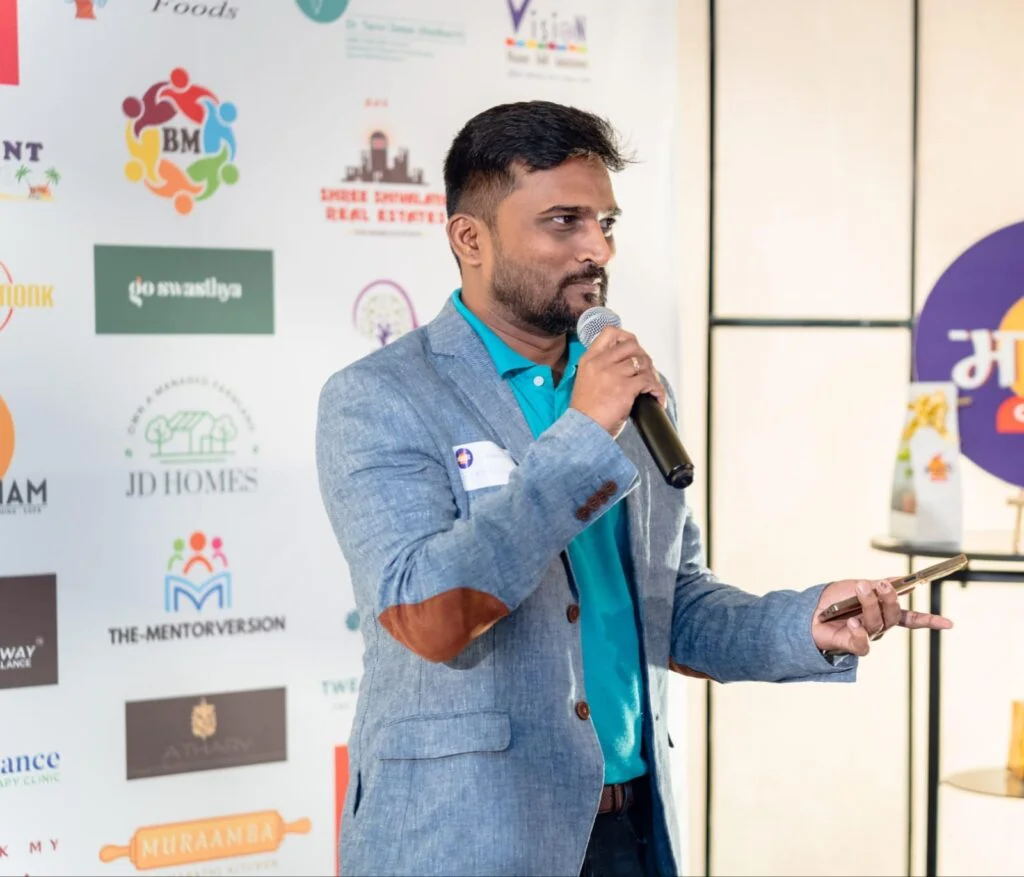
Let’s start at the beginning—tell us a bit about your journey before BookMyPooja.
I’ve spent about 15 years in the corporate world, and in hindsight, it’s been quite a diverse journey. I started with Accenture before IIM Bangalore, and post-IIMB, I moved into retail, working with brands like Victoria’s Secret and Debenhams in the Middle East.
That phase was very consumer-facing and operationally intense. Later, I transitioned into SaaS with companies like Easy Rewards and Sprinklr, where the focus shifted more towards customer experience and account management.
At that time, these were just career moves, but looking back, I can see how much of that experience, especially around understanding customer journeys, has shaped how I think about building BookMyPooja.
What was the moment or experience that led you to start BookMyPooja?
It actually started very simply. We were trying to organise a pooja, and it shouldn’t have been that difficult.
But it turned out to be surprisingly complicated. Finding the right priest, figuring out what exactly needed to be done, even understanding what the right pricing looked like, everything felt unclear.
And what stayed with me was this: something that’s meant to be peaceful ended up feeling quite stressful.
We eventually got it done, but the process itself didn’t feel right. That’s when I started thinking, if this is the experience for us, it’s probably not very different for many others.
You’re working in a very personal and sensitive space. How did that shape your approach to building the platform?
Very early on, we realised that this cannot be approached like a typical tech platform.
In most categories, you optimise for speed. But here, that doesn’t really work. People want to talk, ask questions, and feel reassured before they go ahead.
So we started thinking of it less as a tech product and more as a tech-assisted service.
The platform helps with discovery and structure, but a large part of the experience is still human, through conversations, guidance, and helping people understand what needs to be done. And that’s intentional.
What were the biggest gaps you noticed, and how did you start solving for them?
If I had to summarise it, people were really looking for clarity.
What exactly is the ritual? What do I need to arrange? What will the priest bring? How much should this cost?
These are simple questions, but they weren’t easy to answer.
So we started breaking things down, almost obsessively. Today, we’ve mapped over 500 poojas and around 1,500 packages, but that came from trying to remove even the smallest point of confusion.
It’s not just about listing services. It’s about making sure someone can go through the entire process without second-guessing anything.
This space traditionally runs on trust and referrals. How do you build that as a platform?
That’s probably the hardest part.
Traditionally, people rely on someone they know, a family reference, a friend, someone who has already done a similar pooja. That’s where trust comes from.
We didn’t try to change that behaviour. Instead, we tried to understand what makes that system work.
It’s reassurance, familiarity, and the ability to ask questions.
So we built around that. We don’t push people to just book instantly. We support them through conversations, provide clarity upfront, and ensure consistency in experience.
Over time, once someone has a good experience, they come back. That’s when the platform itself starts becoming referable.
As you started building BookMyPooja, what stood out to you about how this space functions on the ground?
One of the biggest realisations was how unstructured this space really is.
There’s a wide spectrum in how things are done, both in terms of rituals and in how priests interact with clients. And initially, there was also some hesitation around the idea of a platform.
So a large part of the journey became about understanding that ecosystem better, not just from a service standpoint, but from a people standpoint.
We spent a lot of time on onboarding, setting expectations, and finding ways to align traditional practices with what today’s users are comfortable with.
Over time, it also became clear that there’s a larger role to play beyond just enabling access. Things like documentation, basic financial inclusion, and helping them navigate formal systems are areas where even small interventions can make a difference.
That part of the journey has been as important as building the client side of the platform.
Beyond the platform, we also came across your involvement in initiatives around the respectful disposal of old idols and religious items. How did that come about?
That actually came from something we were noticing on the ground.
A lot of people didn’t really know what to do with old or damaged idols and photos. You would often see them left under trees or near garbage areas, not out of disrespect, but because there wasn’t a clear or accessible way to handle them.
Traditionally, this may have been fine when materials were biodegradable, but today many of these items are made of plastic, metal, or treated wood, which creates both environmental and practical concerns.
So we started working with a few community groups to create a more structured approach. The idea was to ensure that these items are handled with dignity from a spiritual standpoint, while also being mindful of how they are processed or recycled.
It’s still evolving, but it reflects a broader gap in the ecosystem. In many ways, it’s not very different from the problem we’re solving with BookMyPooja—bringing some structure and clarity to spaces that have traditionally been informal.
What does BookMyPooja look like today in terms of scale, reach, and traction?
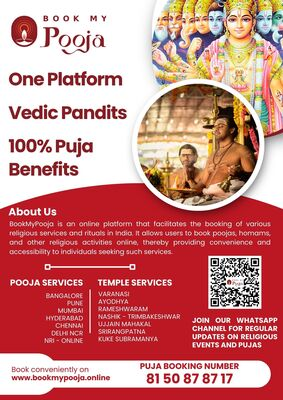
We’re currently present across major cities, Bangalore, Delhi, Mumbai, Chennai, Hyderabad, and Indore.
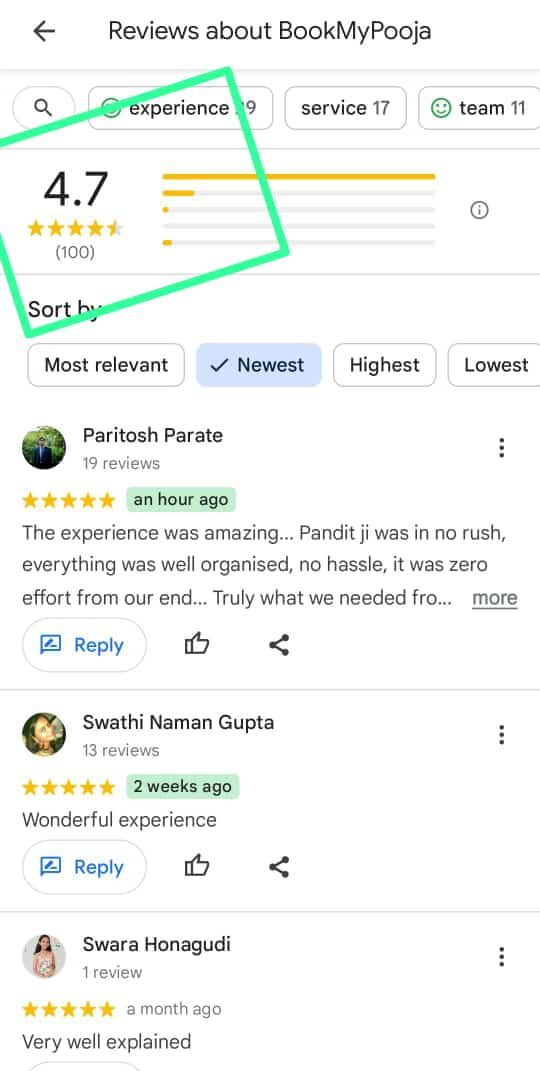
So far, we’ve served over 10,000 families, and that number continues to grow. Our user ratings have also been consistently in the 4.7 to 4.8 range, which gives us confidence that the experience is working.
We’ve also introduced e-pooja services, which have been especially useful for families living abroad or those who can’t be physically present.
Beyond usage, we’ve started seeing encouraging visibility as well, whether through user feedback, media conversations, or community engagement. We recently did a podcast that saw strong traction in a short time, and we’ve also been part of broader discussions around how rituals are evolving in urban contexts.
How would you describe the users who resonate most with your platform, and how do you see that evolving across different communities over time?
Primarily urban users, people who are time-constrained but still value these practices.
Typically, they are in the 28-plus age group and are going through life-stage events, getting married, moving homes, or starting families.
They are not looking to replace tradition. They are just looking for a more manageable way to engage with it.
At the same time, we have started seeing conversations coming in from other communities as well. For example, there have been discussions around Jain communities, and even from groups like Zoroastrians and Jews, where there are similar needs in terms of accessing organised support.
Each of these comes with its own context and sensitivities, so it is not something you can approach in a standardised way. For now, the focus is still on building depth in what we are doing, and then seeing how it can evolve from there.
What are some of the interests you’ve developed along the way, and how have they evolved over time?
One of the more unexpected outcomes of this journey has been the interests it led me to explore.
As I started going deeper into this space, I realised that to really understand it, I had to go beyond just the operational side. That naturally led me to explore areas like astrology more seriously.
What began as curiosity gradually turned into something I genuinely enjoy. I don’t really look at it as prediction. It’s more like a framework to understand patterns, people, and situations better.
Over time, I also felt the need to organise these learnings and experiences more clearly. That’s what led me to start working on a book, Altar Ego: Ancient Vedic Rituals for Modern Souls. It’s still in progress, but the idea is to make these perspectives more accessible to a modern audience.
Alongside that, I do engage with people occasionally through one-on-one consultations, more out of interest than anything else. It’s been a very different, but quite enriching, dimension of this journey.
What stayed with you from your time at IIM Bangalore, and how does it show up in what you’re building today?
One of the biggest things that stayed with me is the way of thinking.
It’s less about specific concepts and more about how you approach problems—breaking them down, looking at them from multiple perspectives, and being comfortable with ambiguity.
That has shown up quite directly in what I’m building now. This space isn’t straightforward, and there aren’t clear playbooks. So a lot of it comes down to understanding the problem deeply before trying to solve it.
The other thing is the peer network. That stays with you in a very real way. It gives you perspective, a sounding board, and sometimes just a different way of looking at things when you’re too close to a problem.
In many ways, both the structure and the openness you develop there continue to influence how you think and build.
What BookMyPooja is attempting is not just about bringing convenience into a traditional space. It is about introducing structure where there has largely been informality, while still respecting the sensitivity and meaning that come with it.
In doing so, it reflects a broader shift in how urban users are engaging with tradition today. Not by moving away from it, but by finding ways to stay connected in a manner that fits their lives.
